
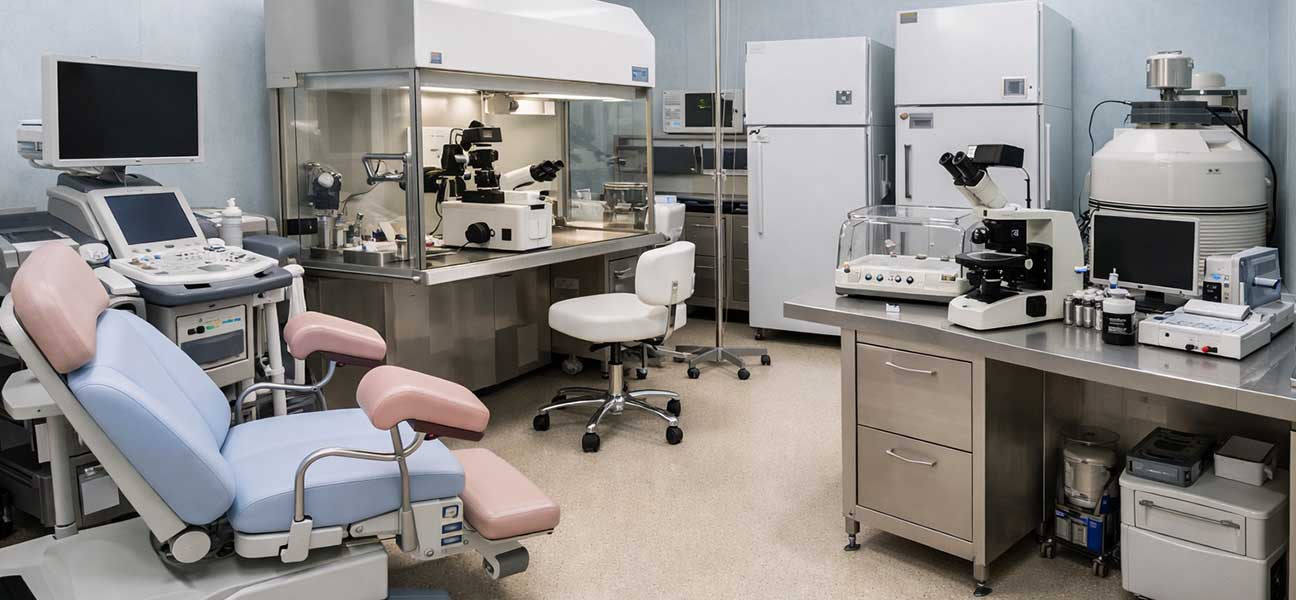
Opening: Examination report scenario
📋 A monthly environmental monitoring report from a tertiary hospital's reproductive center in East China in 2024 showed: the average settle plate count in the embryology lab was 0.3 CFU/plate·4h, the average airborne viable particle count was 0.6 CFU/m³, temperature and humidity were stably controlled at 24±1°C / 55±5%, and the pressure differential gradients between functional areas all met standards. Behind these figures lies a snapshot of the daily hygiene management in Chinese IVF hospitals.
Hygiene Conditions in Chinese IVF Hospitals: Basic Conclusions
Medical institutions in China performing assisted reproductive technology are strictly bound by the National Health Commission's "Administrative Measures for Human Assisted Reproductive Technology" and "Quality Control Standards for Assisted Reproductive Technology." The cleanliness of embryology labs in licensed reproductive centers must reach at least Class 10,000 (ISO 8), with core operational areas (such as embryo culture rooms and micromanipulation rooms) typically requiring Class 1,000 (ISO 6) or even Class 100 (ISO 5). Overall, for reproductive centers that have passed national review, there is a clear industry baseline for hygiene conditions. However, due to differences in establishment time, management level, and equipment investment among hospitals, measurable differences in actual environmental quality exist.
Why Hygiene Conditions Directly Affect Embryo Outcomes
Embryo development is extremely sensitive to the environment, mainly reflected in three aspects:
- Direct Damage from Pollutants: Volatile organic compounds (VOCs), formaldehyde, and microbial metabolites in the air can dissolve into the culture medium and enter the embryo's microenvironment, interfering with cell division and gene expression.
- Impact of Temperature Fluctuations: Embryo culture requires a constant temperature environment. Fluctuations exceeding ±0.5°C can affect spindle stability, increasing the risk of chromosomal abnormalities.
- Microbial Contamination: Contamination by bacteria, fungi, or mycoplasma can lead to embryo developmental arrest or fragmentation, sometimes requiring the discard of entire batches of embryos.
Therefore, hygiene conditions are not a "nice-to-have" soft indicator but a hard prerequisite for normal embryo development.
Doctor's Perspective: Hygiene Conditions are the Core Competitiveness of the Lab
When reproductive doctors choose or evaluate a partner laboratory, hygiene conditions are one of the primary considerations. In clinical decision-making, doctors focus on the following issues:
- Has the laboratory passed national or provincial quality control reviews?
- What is the cleanroom grade? Do core areas reach Class 1,000 or Class 100?
- Are environmental monitoring data regularly disclosed? How are abnormal values handled?
- Does the laboratory have an independent HVAC system and backup power supply?
From a doctor's perspective, a laboratory with up-to-standard hygiene conditions will yield more stable embryo culture results (such as fertilization rate, cleavage rate, blastocyst formation rate), leading to higher confidence in clinical decisions.
How Hygiene Management is Implemented: From Patient Entry to Embryo Transfer
A complete hygiene management chain includes the following key steps:
- Patient Screening and Infection Control: Before starting a treatment cycle, patients must undergo screening for infectious diseases like Hepatitis B, Hepatitis C, Syphilis, and HIV. Positive specimens are handled in designated areas, and incubators are used in separate zones.
- Personnel Access Management: Lab personnel must change into dedicated clean suits, caps, masks, and shoe covers, and pass through an air shower. Patients do not enter the core area of the embryology lab.
- Air Purification and Temperature/Humidity Control: The HVAC system runs 24/7 with primary, medium, and high-efficiency (HEPA) filtration. The core area has an air change rate ≥25 times/hour, maintaining a positive pressure environment.
- Environmental Monitoring and Feedback: Temperature, humidity, and pressure differentials are recorded daily; settle plate and airborne viable particle tests are performed weekly; a comprehensive environmental assessment is conducted monthly, with data archived for review.
- Emergency Plans: In case of equipment failure or contamination alarm, backup systems are activated immediately, the impact on embryos is assessed, and cycles are paused or embryos transferred if necessary.
Core Indicator Interpretation: How to Judge Hygiene Levels
The following table lists the core indicators for embryology lab environmental monitoring and their industry reference ranges:
| Indicator | Test Method | Reference Standard (Class 10,000 Cleanroom) | Explanation |
|---|---|---|---|
| Settle Plate Count | φ90mm plate exposed for 4h | ≤3 CFU/plate·4h | Reflects the load of settleable airborne microorganisms |
| Airborne Viable Particles | Airborne particle sampler | ≤10 CFU/m³ | Reflects the concentration of microorganisms suspended in the air |
| Temperature | Continuous monitoring record | 24±1°C | Temperature fluctuation inside embryo incubators should be even smaller |
| Relative Humidity | Continuous monitoring record | 55±5% | Humidity affects the osmotic pressure stability of the culture medium |
| Pressure Differential | Pressure gauge | ≥5 Pa (core area to outer corridor) | Maintains airflow direction, prevents contamination entry |
| Air Change Rate | Air volume hood/anemometer | ≥25 times/hour | Ensures air renewal and dilution of pollutants |
Data reference: Relevant clauses from the "Quality Control Standards for Assisted Reproductive Technology" and "Architectural Technical Code for Hospital Clean Operating Department." Review details may vary slightly by region.
Easily Overlooked Details: Hygiene Blind Spots from a Patient's Perspective
When evaluating a hospital's hygiene conditions, patients often overlook the following aspects:
- Lab "Age" and Maintenance Records: In older labs, cleanroom sealing and HVAC system efficiency may decline. If maintenance records are incomplete, actual environmental quality might not meet standards.
- Incubator Density: Too many incubators in one lab can lead to cumulative heat dissipation and pollutant release, making local environmental control more difficult.
- Personnel Traffic Frequency: Frequent entry and exit of lab personnel increases the risk of contamination introduction. Observe if the lab has strict access control and entry/exit registration systems.
- Waste Disposal Process: Whether medical waste is temporarily stored in a separate area and disposed of daily is a crucial part of infection control, but patients usually cannot see this directly.
Common Misconceptions About Hygiene Conditions When Choosing a Hospital
- Misconception 1: "Higher hospital grade means better hygiene conditions."
While tertiary hospitals have strong overall capabilities, the cleanroom grade of a reproductive center's lab does not directly correspond to the hospital's grade. Some specialized reproductive centers or newly established facilities may have lab hardware reaching Class 100 standards, whereas some established tertiary hospitals' labs might only maintain Class 10,000 standards due to building constraints. - Misconception 2: "New hospitals are always cleaner than old ones."
New hospitals have new hardware, but the initial operational management process磨合 and staff training are equally critical. Although older hospitals may have older buildings, their hygiene conditions can still be reliable if they have mature maintenance systems and strict quality control. - Misconception 3: "Only look at success rates, ignore hygiene indicators."
Success rates are influenced by multiple factors like patient age, ovarian function, and sperm quality; hygiene is just one component. However, labs with substandard hygiene conditions often show greater fluctuation in success rates, and the reasons can be difficult to explain. It is advisable to also review the lab's quality control reports and embryo culture data.
Observations from a 10-Year Consultant: The Real Picture of Hygiene in Chinese IVF Hospitals
Over the past ten years in the field, I have seen a clear upward trend in the overall hygiene conditions of Chinese reproductive centers. Around 2015, some centers still used ordinary air conditioning systems plus UV disinfection to maintain the lab environment. Today, the vast majority of nationally approved reproductive centers are equipped with independent HVAC systems and online environmental monitoring platforms.
However, differences still exist:
- Leading Reproductive Centers (>5,000 cycles/year) typically have Class 100 core areas, fully automated environmental monitoring systems, backup generators, and highly standardized hygiene management processes.
- Medium-Sized Reproductive Centers (1,000-5,000 cycles/year) mostly meet Class 10,000 standards with Class 1,000 core areas and have comprehensive quality control systems, but lag behind leading centers in equipment redundancy and emergency response capabilities.
- Some New or Remote Area Reproductive Centers meet hardware standards but lack operational experience, and the stability of their actual environmental data needs improvement.
Special Situations: When Hygiene Conditions Become a Decision Variable
In the following clinical scenarios, the weight of hygiene conditions needs to be increased:
- Previous Poor Embryo Development or Repeated Fertilization Failure: If patient-related factors are ruled out and the cause remains unclear, evaluate whether the lab environment meets standards. Consider changing centers if necessary.
- Advanced Age or Low Ovarian Reserve: With few available embryos, each one is extremely precious. Prioritize centers with strict lab quality control.
- Planning for PGT (Preimplantation Genetic Testing): PGT requires embryo culture to the blastocyst stage and biopsy, demanding higher culture environment and operational cleanliness. Choose a lab with a Class 100 core area.
- Patient Has an Immune or Infectious Disease: Assess whether the lab's infection control procedures can effectively isolate risks and prevent cross-contamination.
When can hygiene conditions be a secondary consideration? If the patient is ≤35 years old, has normal ovarian function, no history of poor embryo culture, and the conveniently located reproductive center has passed national review, it can usually meet basic requirements.
Frequently Asked Questions
Q: How can I obtain hygiene condition data for a reproductive center?
A: You can ask if the lab has passed national or provincial quality control reviews, if it has annual environmental monitoring reports, and what the cleanroom grade of the core area is. Reputable centers usually provide this information.
Q: Do reproductive centers with better hygiene conditions necessarily have higher success rates?
A: Hygiene conditions are an important factor affecting the stability of embryo culture, but not the only one. The patient's own condition is equally critical. However, the success rate ceiling of centers with substandard hygiene conditions is significantly limited.
Q: How can I quickly assess hygiene levels during a visit?
A: Observe the cleanliness of the lab's periphery, the strictness of personnel entry/exit procedures, whether environmental monitoring data (e.g., temperature, humidity, pressure differential) are displayed, and whether clean suits are worn correctly.
Q: Is there a relationship between hygiene conditions and fees?
A: Lab construction and maintenance costs are a significant part of a reproductive center's operating costs. The construction and maintenance costs for a Class 100 cleanroom are significantly higher than for Class 10,000. However, fee structures are influenced by region, hospital grade, insurance policies, and other factors, so there is no simple direct correlation.
📌 Check Reminder: Hygiene-Related Items to Confirm Before Your Appointment
- Confirm whether the reproductive center holds the "Human Assisted Reproductive Technology Approval Certificate" issued by the National Health Commission and the result of its most recent inspection.
- Ask about the cleanroom grade of the embryology lab (Class 10,000, Class 1,000, or Class 100), and the date and key data of the most recent environmental monitoring report.
- Find out if the lab has an independent HVAC system, backup power supply, and contamination emergency plan.
- Pay attention to infection control procedures: whether infectious disease screening is completed before starting the cycle, how positive specimens are handled, and whether incubators are used in separate zones.
- If possible, request to see the lab's annual quality control report or an environmental monitoring summary.
The above information can serve as a reference framework for evaluating the hygiene conditions of a reproductive center, helping you make a more balanced decision.










Comments (0)