
A couple who had been unable to conceive for three years walked into the consultation room. The husband's first question was, "We want to find out where to do IVF legally. The information online is too chaotic, and we can't tell what's real." The wife added, "Some people say just look for a hospital with a fertility center sign, others say you need to check the list on the NHC website, and some say private clinics are all unreliable. Which method is actually correct?"
This question appears almost weekly in outpatient clinics and consultations. There is only one core method for verifying a legitimate fertility center: cross-check against the official "List of Medical Institutions Approved to Provide Assisted Reproductive Technology" published by the National Health Commission (NHC). All other information should be cross-verified based on this list.
Official Certification Standards for Legitimate Fertility Centers
China implements a strict准入 system for assisted reproductive technology. Any institution wishing to perform artificial insemination (AIH/AID), in vitro fertilization-embryo transfer (IVF), intracytoplasmic sperm injection (ICSI), or preimplantation genetic testing (PGT) must obtain the "Approval Certificate for Human Assisted Reproductive Technology" issued by the National Health Commission or the provincial health commission.
As of the end of 2024, there are approximately 600 medical institutions nationwide approved to provide assisted reproductive technology, distributed across 31 provinces, autonomous regions, and municipalities. This list is updated annually. The names, addresses, approved technology scope, and license numbers of all licensed institutions are available on the NHC official website.
Core Judging Standard: Whether an institution is legitimate does not depend on whether it is public or private, its scale or decoration, or its advertised "success rate." It depends solely on whether it holds a valid "Approval Certificate for Human Assisted Reproductive Technology" and whether its technology scope covers the specific procedure you need.
Specific Steps for Querying the NHC Official Website
The query path is fixed and requires no special permissions. Here is the complete operational process:
| Step | Action | Notes |
|---|---|---|
| Step 1 | Go to the National Health Commission official website (www.nhc.gov.cn) | Ensure it is the official domain; do not click on ad links directly from search engines. |
| Step 2 | In the search box on the homepage, enter "assisted reproductive technology" or "list of medical institutions for human assisted reproductive technology" | The more precise the keyword, the more direct the result. |
| Step 3 | Find the latest published "List of Medical Institutions Approved to Provide Assisted Reproductive Technology" and download it | Pay attention to the publication date to ensure it is the most recent version. |
| Step 4 | Search for the full name of the target institution in the list, verifying the address, approved technology scope, and license number | The institution's name must match exactly; abbreviations or former names require further verification. |
| Step 5 | If the institution is not found in the list, call the Medical Administration Department or Maternal and Child Health Department of the relevant provincial health commission to verify | The local health commission has the final authority for interpretation. |
The entire verification process usually takes 10-15 minutes. If the target institution is not on the list, it means it has not obtained the qualification to provide assisted reproductive technology, or its qualification has expired, been suspended, or revoked.
Supplementary Query on Provincial Health Commission Lists
Some provincial health commission websites also publish lists of assisted reproductive institutions within their province, and these updates may be faster than the national NHC list. It is recommended to check both the national NHC and provincial health commission channels for cross-confirmation.
Key Points for Verifying the Assisted Reproductive Technology License
The "Approval Certificate for Human Assisted Reproductive Technology" is direct proof of an institution's legality. When verifying, pay attention to the following four key pieces of information:
- Institution Name: Must exactly match the name on the business license and the "Medical Institution Practice License." Pay attention to whether names like "Branch," "Cooperative Campus," or "Fertility Center" are reflected on the license.
- Technology Scope: The license will clearly list the approved technology items, such as "Artificial Insemination by Husband," "Artificial Insemination by Donor," "Conventional In Vitro Fertilization-Embryo Transfer," "Intracytoplasmic Sperm Injection," "Preimplantation Genetic Testing," etc. The institution can only perform technologies within its licensed scope.
- Validity Period: The license has a clear effective date and expiration date. Operating beyond the expiration date without renewal is considered unlicensed practice.
- Issuing Authority: Must be stamped and issued by the National Health Commission or the provincial health commission. "Certifications," "authorizations," or "cooperation certificates" issued by other organizations or associations are not substitutes.
Special Note: Some institutions may display copies of the license on their website or in the clinic, but these copies could be altered or expired. The most reliable method is to verify the number and validity period yourself on the NHC official website.
Qualification Requirements for Different Assisted Reproductive Technologies
Different technologies have different requirements for personnel, equipment, and laboratory conditions, so qualification approval is tiered. An institution having IVF qualification does not mean it has PGT qualification.
| Technology Type | Abbreviation | Approval Level | Approximate Number of Licensed Institutions (as of 2024) |
|---|---|---|---|
| Artificial Insemination by Husband | AIH | Approved by provincial health commission | Approx. 550 |
| Artificial Insemination by Donor | AID | Approved by provincial health commission, requires special evaluation | Approx. 80 |
| Conventional In Vitro Fertilization-Embryo Transfer | IVF | Filed with NHC, approved by provincial health commission | Approx. 500 |
| Intracytoplasmic Sperm Injection | ICSI | Approved in the same batch as IVF | Approx. 500 |
| Preimplantation Genetic Testing | PGT | Special approval by NHC | Approx. 80 |
When querying, you must not only confirm the institution is on the list but also confirm it has the qualification for the specific technology you need. For example, if you need PGT (third-generation IVF), you must confirm the institution is marked on the list as "qualified for preimplantation genetic testing."
Three Most Easily Overlooked Details
During the verification process, the following three details are often overlooked, leading to misjudgment:
Detail 1: The Difference Between the License's Technology Scope and "Services Offered"
Some institutions, although they have IVF qualification, do not have PGT qualification, yet advertise that they "can do third-generation IVF." In reality, they might operate through "cooperative laboratories" or "sending out samples," which poses compliance risks. Legitimate PGT must be completed within the institution itself or an approved joint laboratory, and the institution itself must hold PGT qualification.
Detail 2: Consistency Between the Institution Name and Its Public Signage
Some private institutions use names similar to well-known hospitals, such as "XX University Affiliated Fertility Center" or "XX Hospital Reproductive Medicine Department," but the name on their license may be completely different. Verification must be based on the name on the license.
Detail 3: The Difference Between the List's Update Time and the Actual Practice Status
The NHC list is typically updated 1-2 times a year, but an institution's practice status may change during this period (e.g., suspended, voluntarily revoked). Therefore, after checking the list, it is best to call the Medical Administration Department of the provincial health commission where the institution is located to confirm its current practice status.
Common Verification Mistakes
The following four verification methods are unreliable and may even be misleading:
- Mistake 1: Only looking at the institution's official website. Almost all institutions display "qualifications" and "certifications" on their websites, but this information may be outdated, exaggerated, or forged. The official website is not a reliable channel for verifying qualifications.
- Mistake 2: Believing claims of "cooperating hospitals." Some institutions claim to "cooperate" with a famous hospital or expert but have not obtained independent qualifications. A cooperation model cannot replace the institution's own legal qualification.
- Mistake 3: Being misled by "expert teams." Even if an institution hires qualified experts to consult, if the institution itself has not been approved for the corresponding technology, it still cannot legally provide treatment. The expert's personal qualification does not represent the institution's qualification.
- Mistake 4: Ignoring verification with the local health commission. The national NHC list is the foundation, but the local health commission has the latest information on the institution. Only checking the national list might miss information about penalties or suspensions.
Characteristics of a Legitimate Institution from a Practitioner's Perspective
Based on 10 years of observation in the field, legitimate fertility centers typically have the following five characteristics, which can serve as supplementary criteria for judgment:
- Transparent Qualification Display: The original or a clear copy of the "Approval Certificate for Human Assisted Reproductive Technology" is displayed prominently in the outpatient hall or registration area, and the displayed information matches the NHC official website.
- Standardized Diagnosis and Treatment Process: During the initial visit, the doctor arranges a complete fertility assessment, including female AMH, FSH, LH, antral follicle count, and male semen analysis. They do not skip tests and proceed directly to treatment.
- Clear Fee Structure: All chargeable items are clearly priced, and a fee list is provided before treatment. Vague charging methods like "package price" or "guaranteed success price" are not used.
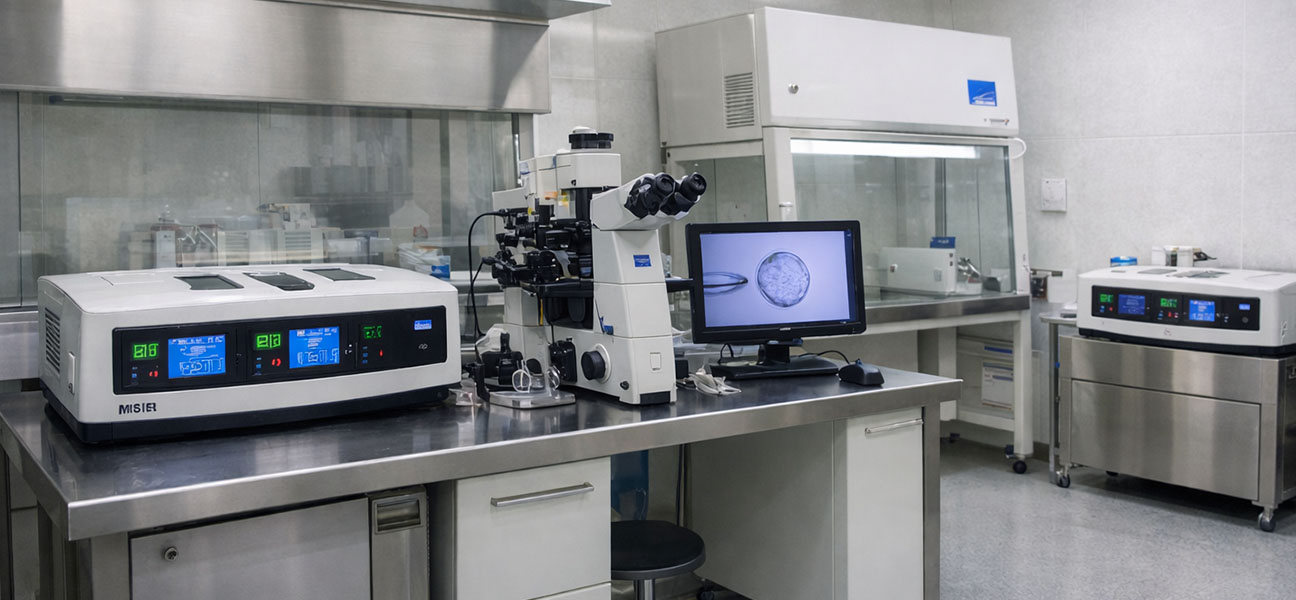
- Adequate Laboratory Conditions: The fertility center has an independent embryology laboratory that meets national standards for cleanliness, temperature, and humidity. Legitimate institutions typically allow patients to view the lab through a viewing corridor.
- No Guarantee of Success: Legitimate institutions inform patients that the success rate of assisted reproductive technology is influenced by multiple factors such as age, ovarian function, sperm quality, and uterine conditions, and success cannot be guaranteed. Any institution promising "guaranteed success" or "guaranteed pregnancy" is suspected of illegal advertising.
Frequently Asked Questions
Q1: Are private fertility centers legitimate?
Whether a private fertility center is legitimate depends on whether it holds the "Approval Certificate for Human Assisted Reproductive Technology" issued by the health commission, not its ownership type. As of 2024, among approximately 600 licensed institutions nationwide, private institutions account for about 40%. The verification method is exactly the same as for public institutions: check the NHC list. Among private institutions, there are those with strong technical capabilities and standardized management, as well as those that have been penalized or had their licenses revoked. Each one needs to be verified individually; they cannot be generalized.
Q2: How can I verify if a fertility center has third-generation IVF (PGT) qualification?
In the list downloaded from the NHC official website, the institution's "approved technology scope" will be clearly marked. If the institution is marked as "qualified for preimplantation genetic testing" or "permitted to conduct PGT," it means it has the qualification. If the list only states "IVF/ICSI," it means it does not have PGT qualification. Another way is to check the institution's "technology access project" announcement on the provincial health commission website. Currently, only about 80 institutions nationwide have PGT qualification, accounting for about 13%.
Q3: How should I interpret the success rate data advertised by fertility centers?
Legitimate institutions report success rates stratified by patient age and technology type, and also publish indicators such as clinical pregnancy rate, live birth rate, and miscarriage rate. If an institution only publishes a vague "success rate" number, or the number is significantly higher than the industry average (live birth rate for under 35 is about 40-50%, for over 40 about 10-20%), and cannot provide detailed statistical methods, the data credibility is questionable. Truly legitimate institutions will inform patients that the success rate is a population statistic and cannot be directly equated to an individual's probability.
Q4: How can I find a local legitimate institution when seeking medical care in another city?
Method 1: Filter by province on the NHC official website list. Method 2: Directly search for "[Province Name] Health Commission assisted reproductive technology medical institution list." Method 3: Call the Medical Administration Department or Maternal and Child Health Department of the provincial health commission where the target institution is located; the phone number is available on the provincial health commission website. It is recommended to cross-confirm through at least two channels to avoid information errors.
When to Re-verify an Institution's Qualification
In the following four situations, it is recommended to re-check the NHC list to confirm whether the institution's qualification is still valid:
- The institution has changed its name, address, or legal representative
- The institution has been exposed in the media for medical disputes or administrative penalties
- More than one year has passed since the last verification
- Within one month before planning to start a treatment cycle







Comments (0)